IN1910 2022
IN1910: Scientific Programming
Four programming projects covering version control, OOP, simulations (double pendulum, random walks), numerics, and software design, with testing using pytest and mypy type checking.
IN1910 - Programming with Scientific Applications at UiO. Four graded projects building Python skills specifically for scientific computing and engineering applications.
Project 0: Version control and tooling
- Git workflow: branching, merging, conflict resolution
- Python environment management with
venvandpip - Writing
README.mddocumentation and structuring a Python project - Introduction to
pytestfor test-driven development
Project 1: Object-oriented programming
- Designing class hierarchies for physical systems
- Operator overloading:
__add__,__mul__,__repr__,__eq__ - Abstract base classes with
abc.ABC - Modelling mathematical objects (vectors, polynomials, complex numbers) as classes
- mypy for static type checking: type annotations,
Optional,Union,List
Project 2: Simulations
The most computationally intensive project. Simulated physical systems numerically:
Double pendulum
- Derived and solved the equations of motion using 4th-order Runge-Kutta (RK4)
- Visualised chaotic behaviour: two nearly identical initial conditions diverge exponentially
- Phase space plots and energy conservation checks
Random walks
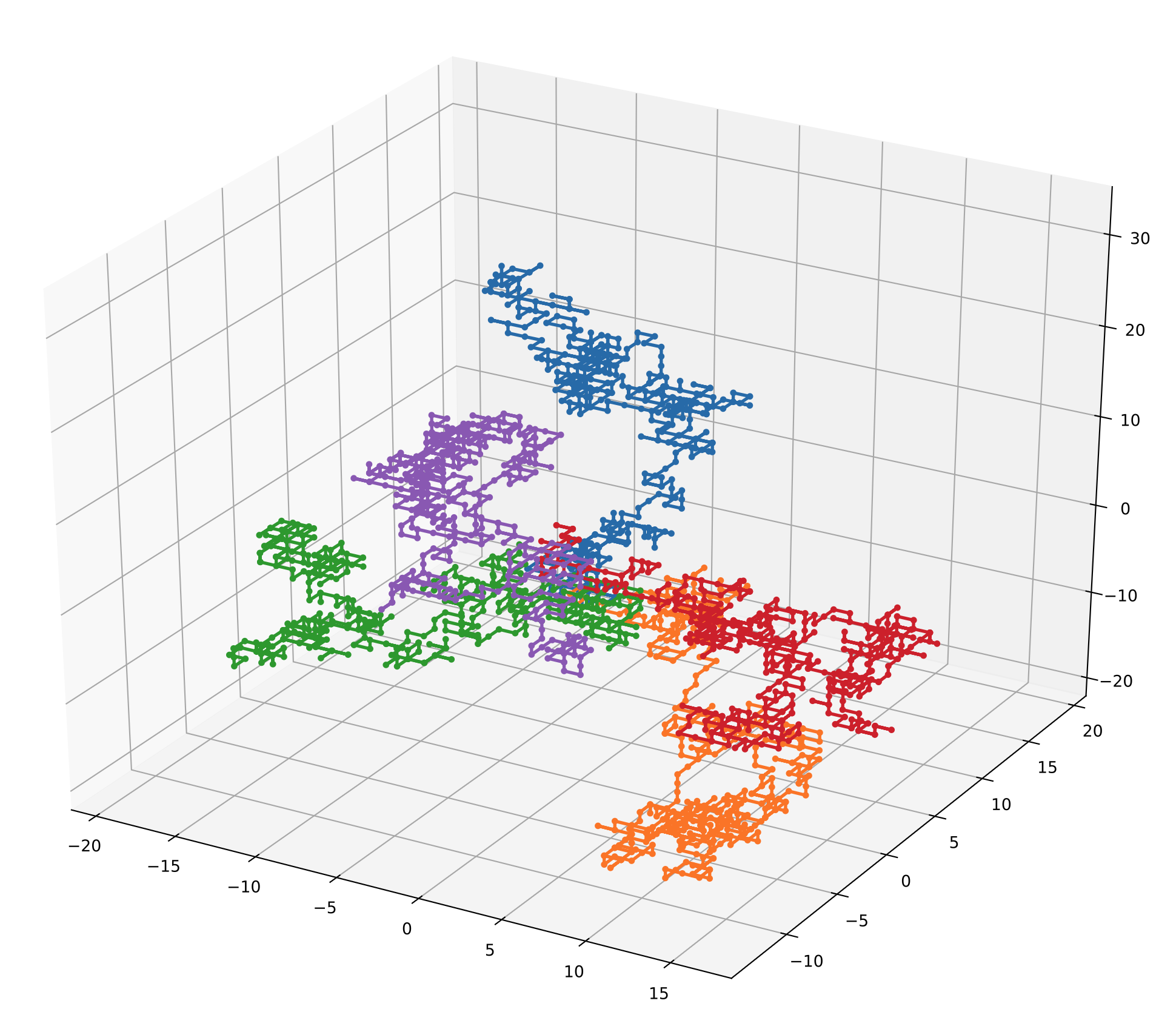
- 1D, 2D, and 3D random walks (the 3D walk visualisation is the repo thumbnail)
- Analysed mean displacement: ⟨r²⟩ ∝ N (scaling with number of steps)
- Applications: Brownian motion, polymer modelling, diffusion
Population dynamics
- Lotka-Volterra predator-prey equations solved with scipy’s ODE solver
- Phase portraits and stability analysis
Project 3: Numerics
- Newton’s method for root-finding, convergence analysis
- Numerical integration: Trapezoidal rule, Simpson’s rule, Gaussian quadrature; error analysis
- ODE solvers: Forward Euler, Runge-Kutta methods, adaptive step size
- Linear systems: Gaussian elimination, LU decomposition using NumPy
- Finite difference methods for PDEs (heat equation 1D)
Project 4: Software design and refactoring
- Refactoring earlier code for maintainability: separating concerns, reducing coupling
- Design patterns: strategy pattern for interchangeable solvers
- Performance profiling with
cProfileandtimeit - Documentation with docstrings and Sphinx
What I learned
Scientific programming is software engineering with different priorities: correctness and reproducibility matter more than raw performance, and testing numerical code requires understanding the expected error bounds. Using mypy throughout the project caught a surprising number of subtle type errors.