IN3130 2024
IN3130: Algorithms & Complexity
Advanced algorithms course covering A*, NP-completeness, dynamic programming, network flow, and algorithm design with rigorous complexity analysis.
IN3130 - Algorithms: Design and Efficiency at UiO. The theoretical core of computer science: understanding why algorithms work, not just how to use them.
Course topics
Complexity theory
- Big-O, Big-Θ, Big-Ω notation: formal definitions, not intuition
- Master theorem for recurrences
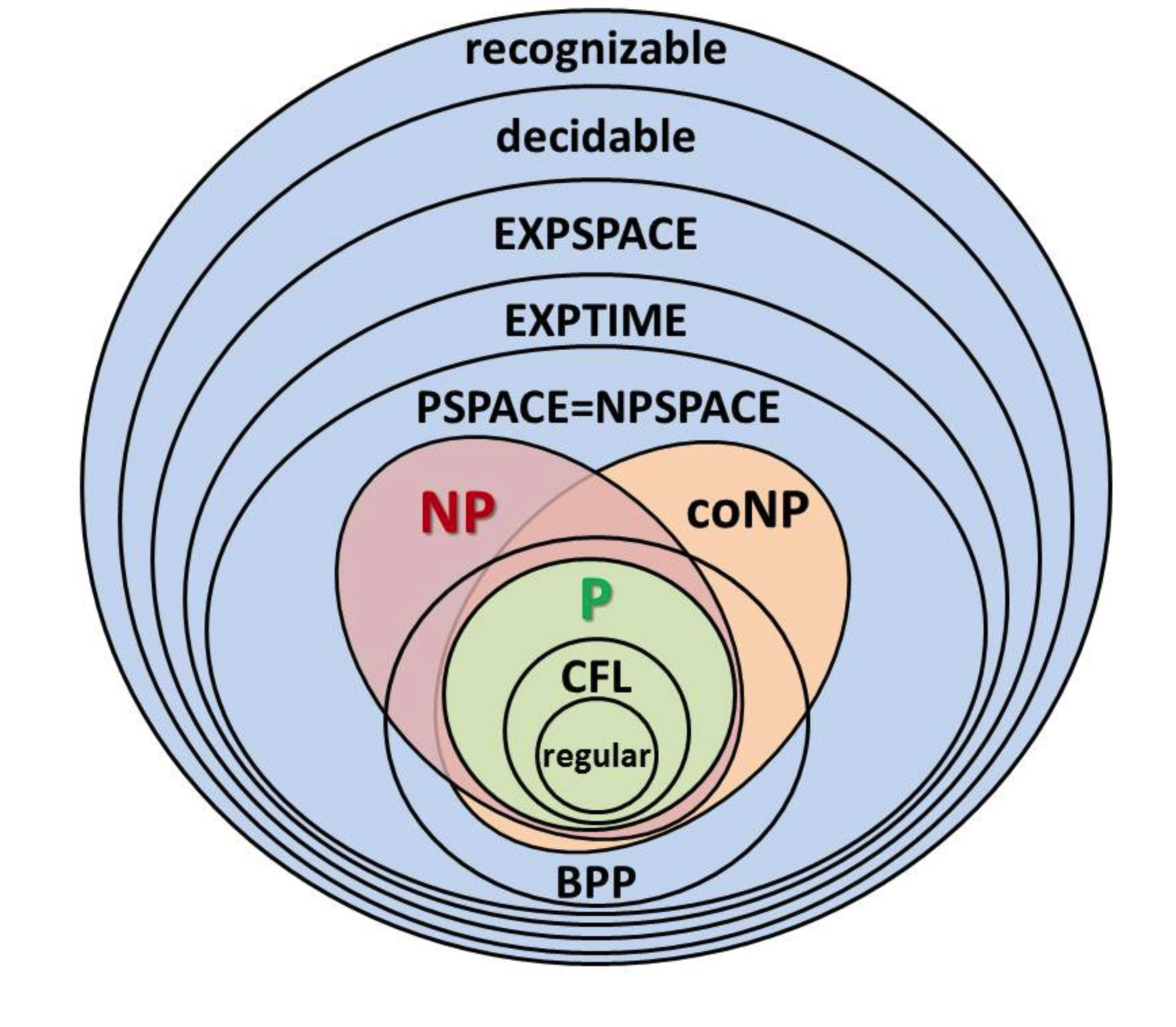
- P vs NP: what it means for a problem to be in P, NP, NP-hard, and NP-complete
- Polynomial-time reductions: proving NP-hardness by reducing from known problems (SAT, 3-SAT, Vertex Cover, Clique)
Graph algorithms
- A* search: heuristic-guided pathfinding, admissibility and consistency of heuristics, comparison to Dijkstra
- Bellman-Ford: shortest paths with negative weights, detecting negative cycles
- Floyd-Warshall: all-pairs shortest paths in O(V³)
- Topological sorting: Kahn’s algorithm and DFS-based approach, applications to dependency resolution
Dynamic programming
- Optimal substructure and overlapping subproblems
- Memoization vs tabulation
- Classic problems: longest common subsequence, edit distance, knapsack, matrix chain multiplication, rod cutting
- Designing DP solutions from scratch (identifying state, transition, base case)
Network flow
- Max-flow / min-cut theorem: Ford-Fulkerson algorithm, augmenting paths
- Bipartite matching via max-flow reduction
- Minimum cost flow: circulation with lower bounds
Greedy algorithms
- Proving greedy correctness with exchange arguments
- Huffman coding, interval scheduling, fractional knapsack
- When greedy works and when it doesn’t (counterexamples)
Algorithm design paradigms
- Divide and conquer: merge sort, quicksort, Strassen’s matrix multiplication
- Branch and bound for exact solutions to NP-hard problems
- Approximation algorithms: 2-approximation for vertex cover, TSP approximation
What this course means in practice
Understanding NP-completeness is practical: when you can prove your problem is NP-hard, you know to look for approximation algorithms or heuristics rather than searching for a polynomial exact solution. The A* implementation in particular was directly useful in GeoScore for pathfinding in graph-based risk data.