IN3230: MIP Network Stack
Built a minimal IP-style network stack in C: a MIP daemon, routing daemon with distance-vector algorithm and poison reverse, IPC, forwarding table, and Mininet testing.
IN3230 - Network Programming at the University of Oslo. Two major projects building a complete minimal network stack from raw sockets in C.
Project 1: MIP Daemon
Implementing a minimal Internet Protocol (MIP), a custom link-layer protocol running over Ethernet frames.
What was built
- MIP daemon: a background process on each network node that handles MIP-level packet routing
- Custom addressing: 8-bit MIP addresses resolved to Ethernet MACs via an ARP-like discovery protocol
- Raw socket programming with
AF_PACKET: reading and writing Ethernet frames directly, bypassing the kernel’s IP stack - Unix domain sockets for IPC between the MIP daemon and user applications (ping tool, file transfer)
- Custom packet format: header with source/destination MIP addresses, TTL, protocol field, and variable-length payload
Network environment
All testing done in Mininet, a software-defined network emulator that creates virtual hosts, switches, and links within a single Linux machine. Topologies can be defined programmatically (star, chain, ring, mesh).
Project 2: Routing Daemon
Added dynamic routing on top of the MIP stack.
Distance-vector routing (Bellman-Ford)
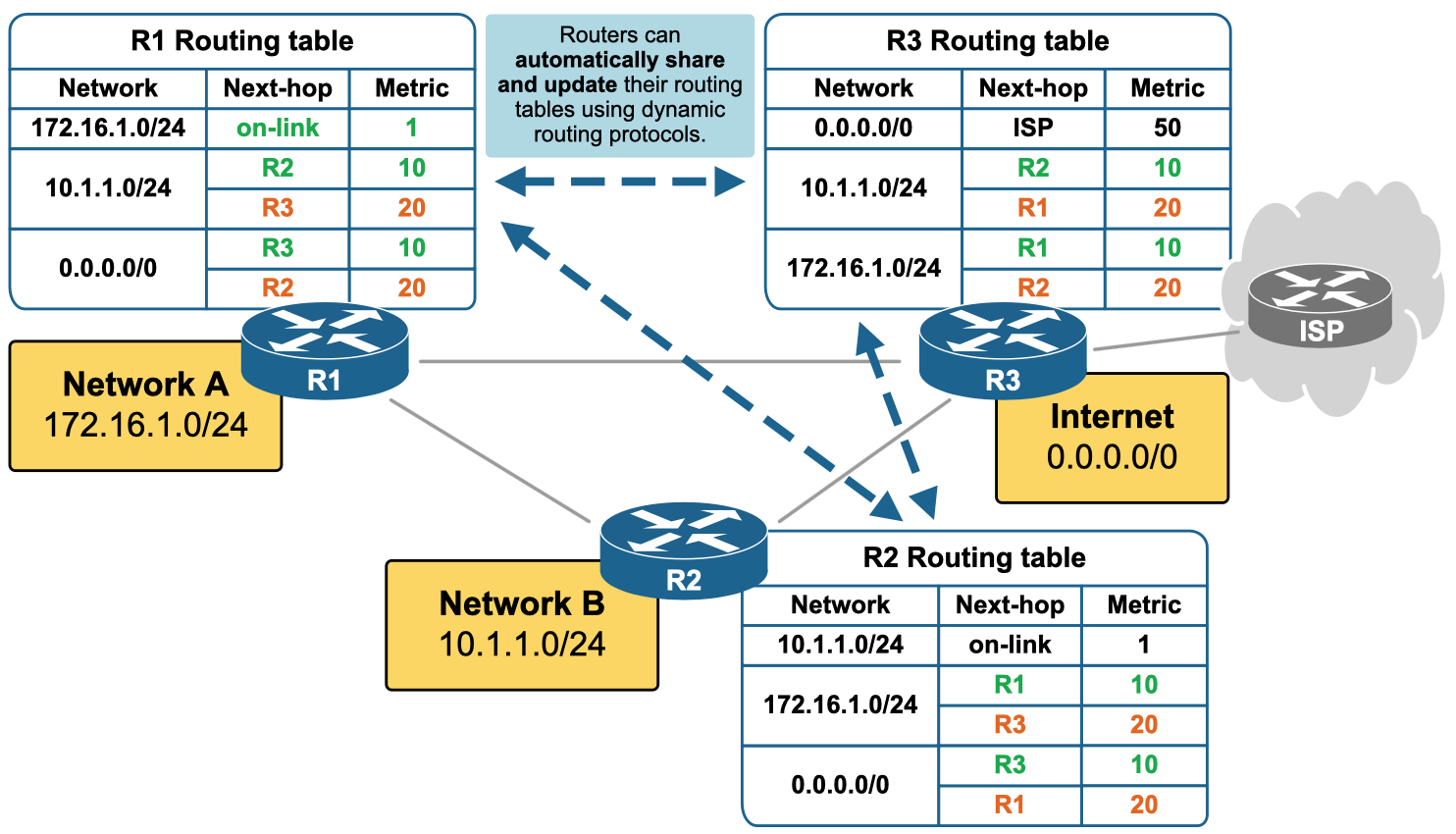
Each router maintains a distance table: destination -> (cost, next-hop). Routers periodically send their full distance vector to neighbours. When a router receives a better path, it updates its table and propagates the change.
Convergence time depends on topology size and the update period, but typically stabilises within 3-5 update rounds.
Poison reverse
Prevents routing loops: if A routes to C via B, A advertises cost ∞ for C back to B. This eliminates the classic “count to infinity” problem for two-node loops.
Multi-hop forwarding
With the routing daemon running, packets traverse multiple MIP routers. Each router:
- Receives the packet on an interface
- Looks up the destination in its forwarding table
- Forwards to the correct next-hop interface
Testing
- Correct convergence after topology changes (link failure, new node joining)
- Poison reverse prevents loops in verified test scenarios
- End-to-end packet delivery measured with custom ping tool built on top of MIP
What this project taught me
Building a protocol stack from scratch makes everything abstract in networking courses click. Understanding byte-order conversions (htons/ntohs), parsing raw Ethernet frames, and debugging with Wireshark inside Mininet gave me a much deeper grasp of how TCP/IP actually works than lecture notes alone.