MIP Network Stack (IN3230)
Custom minimal IP-style network stack built in C: MIP daemon, routing daemon with distance-vector algorithm, poison reverse, IPC, and packet forwarding tested in Mininet.
Two-semester systems project from IN3230: Network Programming at UiO. The goal: implement a working IP-like protocol stack from scratch in C, running in a simulated network environment.
Project 1: MIP Daemon (Minimal Internet Protocol)
The first assignment built the foundation: a MIP daemon that runs on each node in the network and handles packet forwarding at the link layer.
Key components:
- Custom MIP addressing scheme (8-bit MIP addresses mapped to Ethernet MACs via ARP-like discovery)
- Raw socket programming using
AF_PACKETsockets to read/write Ethernet frames directly - IPC between the MIP daemon and application processes using Unix domain sockets
- Packet format: custom header with source/destination MIP addresses, TTL, and payload type
- Tested in Mininet: a software-defined network emulator that creates virtual hosts and links
Project 2: Routing Daemon
The second assignment added dynamic routing on top of the MIP stack.
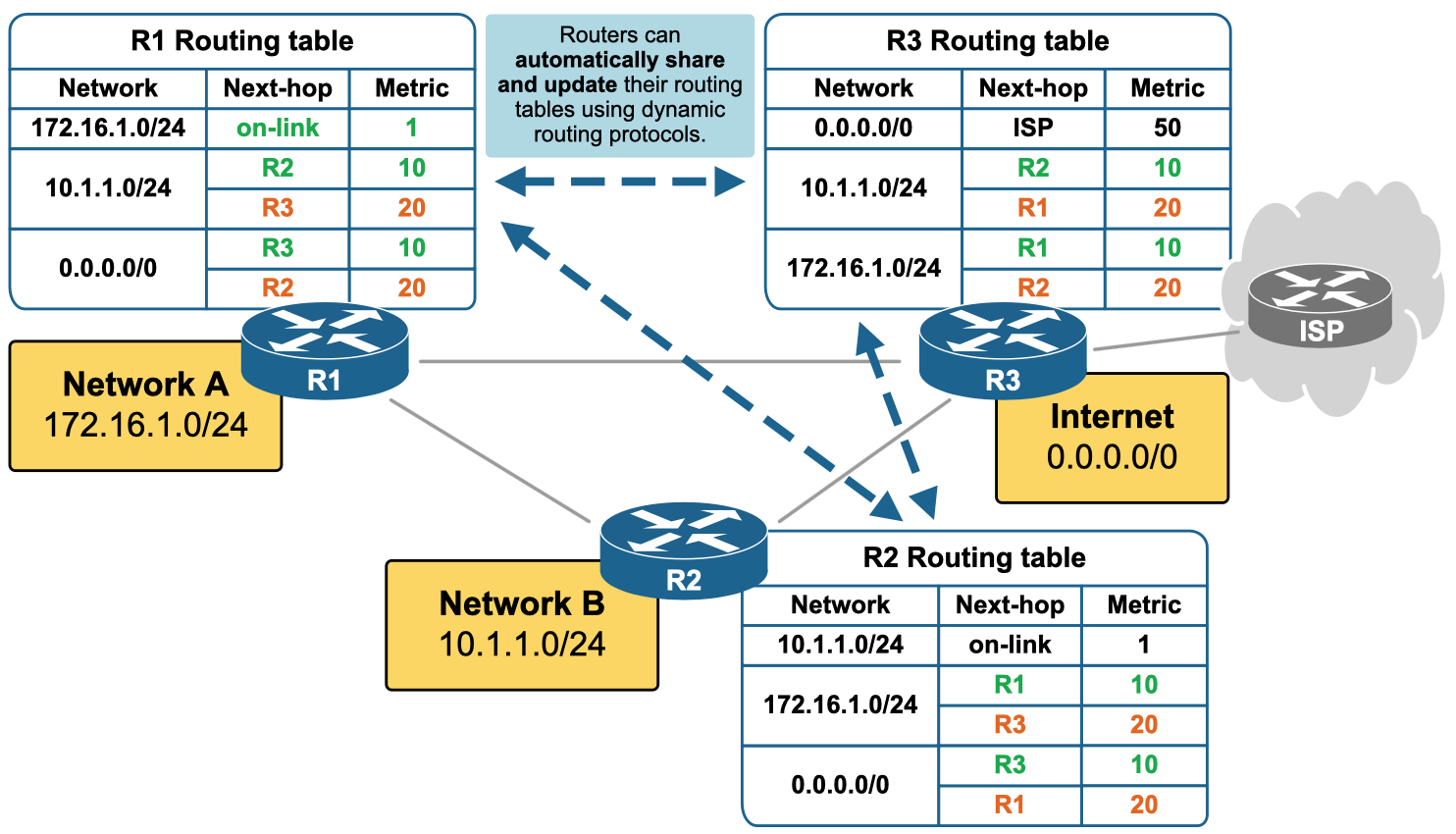
Distance-vector routing (Bellman-Ford):
- Each router maintains a distance table: for every known destination, the cost and next-hop
- Routers periodically broadcast their distance vector to neighbours
- When a shorter path is discovered, the table updates and the change propagates
Poison reverse:
- Prevents routing loops from persisting: if router A routes to C via B, A tells B that C is unreachable via A (cost = ∞)
- Eliminates the “count to infinity” problem for two-node loops
Multi-hop forwarding:
- Packets traverse multiple routers across a simulated topology
- Each router inspects the MIP destination, looks up the forwarding table, and forwards to the correct interface
Testing
All tests run in Mininet with configurable topologies (star, chain, mesh). The routing daemon converges correctly after link failures and recovers when links come back up.
What I learned
Building a protocol stack from scratch makes abstract concepts concrete. Writing the ARP-equivalent discovery, handling byte-order conversions (htons/ntohs) everywhere, and debugging with Wireshark inside Mininet taught me more about how TCP/IP actually works than any course reading.